24/7 Multichannel Support
Consistent support across phone, email, portal and other channels, with coverage designed around the firm's workforce and operating model.

Helpdesk 2.0
Response times and SLA compliance built discipline into IT support, but they answer the wrong question. Opensity's Help Desk model combines sentiment analytics, AI-assisted coaching, and proactive support to measure, and improve, how effectively people actually adopt technology.
Opensity delivers IT support for leading legal, financial and professional services organizations. We combine technical expertise, service discipline and a deep understanding of how people work to deliver more than ticket resolution. We help organizations improve the speed, quality and experience of every support interaction—while using data and AI to continuously improve the service
Consistent support across phone, email, portal and other channels, with coverage designed around the firm's workforce and operating model.
AI-assisted classification, routing and prioritization to get users to the right resource faster.
Skilled analysts supported by clear escalation paths, specialized expertise and consistent service standards.
Searchable, continuously updated knowledge that helps analysts and users resolve common issues faster.
Identify recurring issues, emerging patterns and technology friction before they become larger disruptions.
Measure service quality and user sentiment, then use those insights to coach teams and continuously improve the support experience.
HOW WE EVOLVE THE SUPPORT EXPERIENCE
A high-performing help desk cannot be measured by how quickly it closes today’s ticket alone. As technology changes, users become more sophisticated, and demand shifts, the support model has to evolve with it.
That requires a methodology that moves beyond ticket resolution — building the processes, insights and capabilities to solve faster, prevent recurring issues, anticipate demand and ultimately improve the employee experience.
Our support methodology is built around four stages of maturity, each designed to move the organization from reactive support to proactive business enablement.
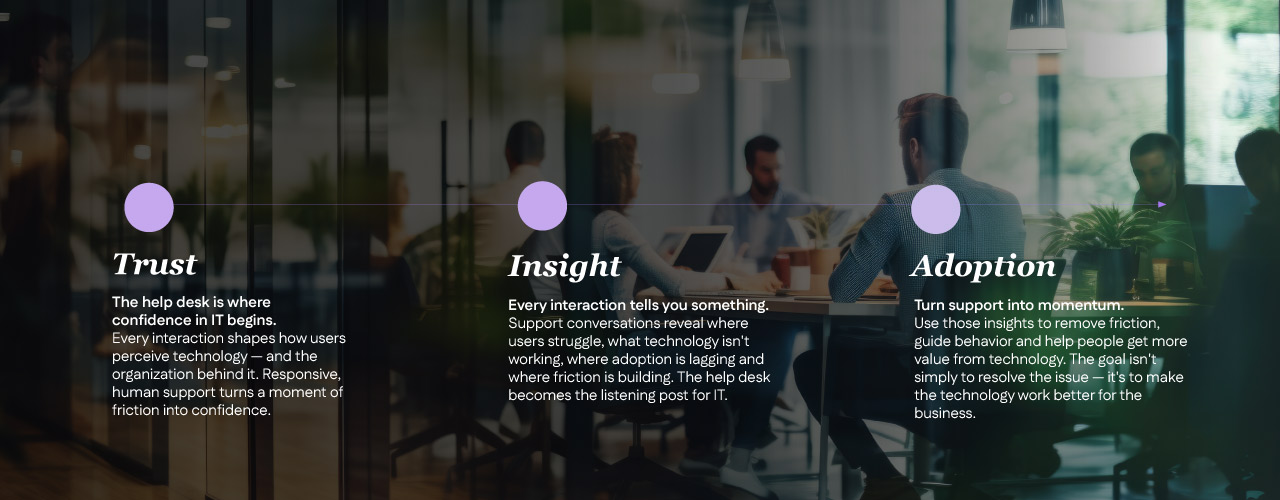
The help desk is more than where users go when technology fails. It is where they form their view of IT.
For most employees, the help desk is IT — the front door to the entire technology experience.
CSAT reflects how someone felt about a single interaction. Sentiment reflects the organization's collective confidence in IT over time — one measures an event, the other a relationship. Post-ticket surveys typically capture only a small share of monthly interactions, so a desk can post strong CSAT while users quietly build workarounds or stop reaching out at all.
It amplifies it instead. Modern platforms can analyze every interaction rather than a small sample, surfacing sentiment shifts, recurring patterns, and coaching opportunities in real time. What they can't do is build trust — that still comes from supervisors coaching better and analysts getting faster, more specific feedback.
A typical audit checks SLA performance. A service maturity assessment goes further — twelve months of ticket history, channel utilization, escalation trends, staffing models, and sentiment indicators, weighted against your business priorities into a maturity index. The output is a roadmap for where to invest next, not another scorecard.
It starts with a maturity assessment against your twelve months of ticket and interaction data. From there, the roadmap points to the highest-leverage investment first — whether that's automation, analyst coaching, knowledge management, or process redesign — rather than layering new technology onto an already strained support model.
Attendance policies can influence where people work, but they don't determine how people experience the workplace. The differentiator is operational excellence—consistent hospitality, seamless meetings, responsive service, and an environment employees value. That's what transforms presence into engagement.
We implement in phases to build a sustainable operating model. We establish service standards, SOPs, staffing, and governance first; then introduce technology, reporting, and performance metrics; and finally optimize hospitality, events, and workplace enhancements once a consistent operational rhythm is in place. Every phase builds on the last, ensuring continuous improvement without disrupting day-to-day operations.
As technology environments grow more interconnected, the most useful indicators are also the least discussed.