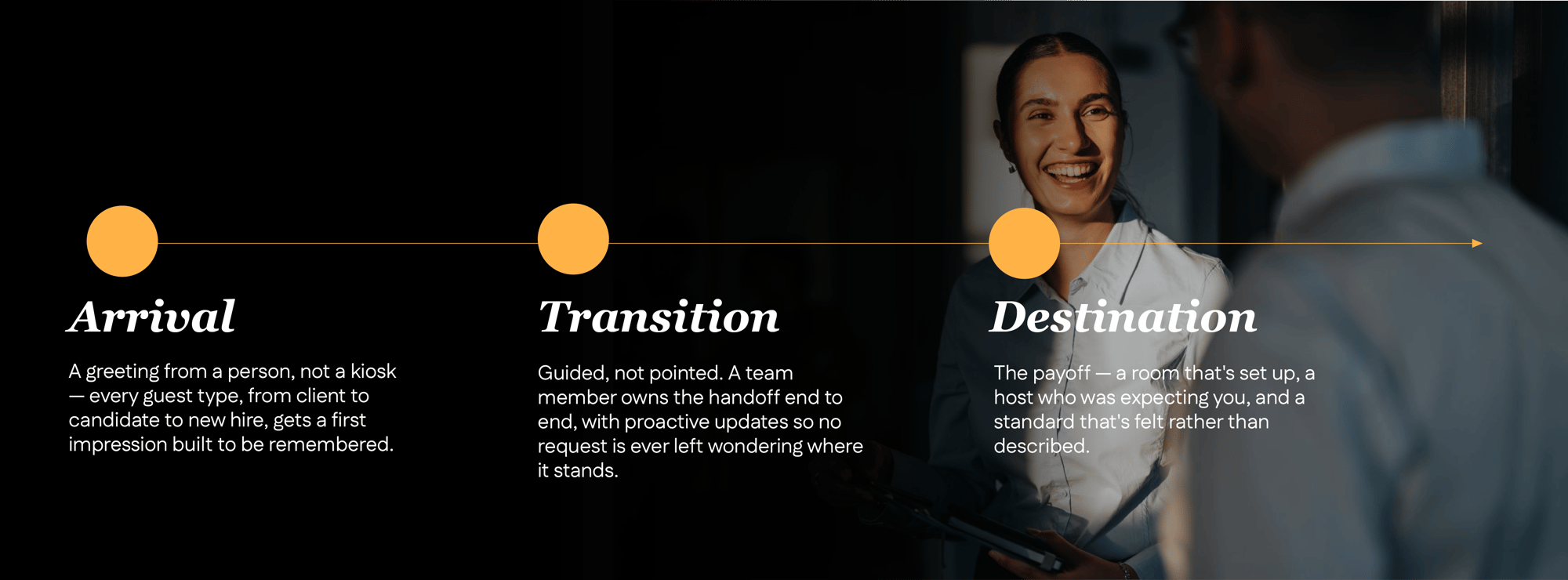
Arrival, Transition & Destination
A mapped guest journey that replaces the badge-scan-and-silent-elevator routine with a warm, owned handoff from door to desk.
- Named greeting, not a kiosk
- Guided transition, not directions
- A room that feels expected

Workplace Experience
Opensity applies the principles of world-class hospitality to the workplace — turning arrival, meetings, dining, and daily support into a flagship experience employees, advisors, and clients actually want to be part of.
A mapped guest journey that replaces the badge-scan-and-silent-elevator routine with a warm, owned handoff from door to desk.
A curated food and beverage program built around how people actually work — not a generic snack wall.
Room booking, setup, and catering logistics taken off the meeting owner's plate entirely — every meeting starts on time.
A single, mobile point of contact for mail, print, facilities, and everyday workplace requests — not another shared inbox.
Real occupancy insight and aggregated service dashboards, replacing anecdote — and ghost bookings — with data.
Every room setup, AV standard, and hospitality expectation codified in one reference — so quality never depends on memory.
Organizations have gotten very good at requiring people to return. Very few have made the office worth returning to — and the gap is now measurable, in vacant seats and in departing talent.
HOW WE PROTECT THE SERVICE STANDARD
Anyone can create a great first impression during implementation. The real test is what happens on day 400—when new hires join, managers change, locations expand, and expectations continue to rise.
That is why our WPX program is built around a continuous improvement operating system: one standard, one training model, one measurement framework, and one commitment to getting better every quarter.
The first sixty seconds set the tone for everything after. Here's how the journey is designed, stage by stage.
Reception and facilities keep the building running. They weren't scoped to own the experience — the greeting, the handoff, the meeting logistics, the food program, all as one connected journey. WPX Coordinators don't replace your team; they close the gap between "the office is staffed" and "the office feels intentional.
Only if it's treated as one. ~19% national office vacancy and 8 in 10 companies losing talent to stricter RTO policy are balance-sheet problems, not comfort problems. A flagship workplace experience is one of the few investments that touches retention, real estate ROI, and client perception at the same time — that's a strategic line, not a perk line.
Most vendors deliver a service catalog. We build an operating standard—documented in a comprehensive Lookbook, reinforced through SOPs, ongoing training, quality assurance, and continuous improvement. Every room, greeting, and meeting setup is executed the same way, every time, by teams trained to deliver a consistent, measurable experience across every location.
Yes—and we'd rather show you the math than the pitch. Every hospitality team member who leaves represents more than a recruiting expense. It means lost service knowledge, inconsistent guest experiences, additional training, and operational disruption. By reducing turnover, standardizing service delivery, and reclaiming hours spent coordinating meetings and events, organizations generate measurable returns long before gains in employee engagement, workplace utilization, and client satisfaction are factored in.
Attendance policies can influence where people work, but they don't determine how people experience the workplace. The differentiator is operational excellence—consistent hospitality, seamless meetings, responsive service, and an environment employees value. That's what transforms presence into engagement.
We implement in phases to build a sustainable operating model. We establish service standards, SOPs, staffing, and governance first; then introduce technology, reporting, and performance metrics; and finally optimize hospitality, events, and workplace enhancements once a consistent operational rhythm is in place. Every phase builds on the last, ensuring continuous improvement without disrupting day-to-day operations.